
Take Off Bolts: Screw Puzzle
Playful BytesPuzzle
4.11.65K Reviews
- Version
- 1.23.0
- Installs
- 10.00M
- Age Rating
- Everyone
Screenshots
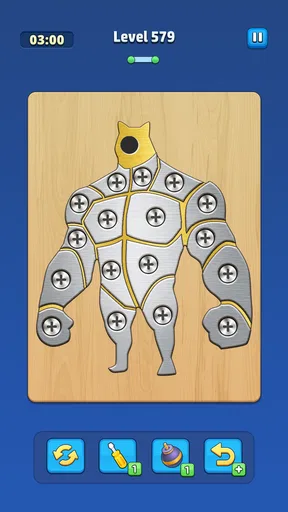
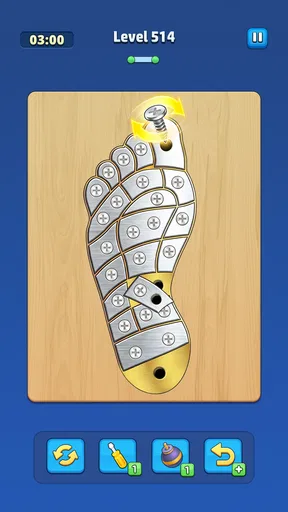
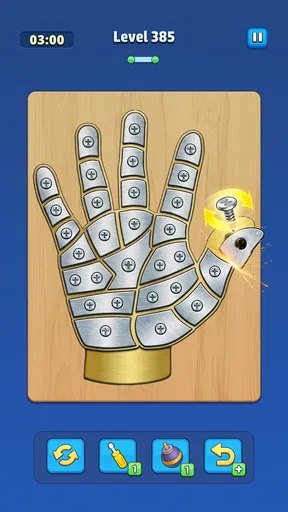
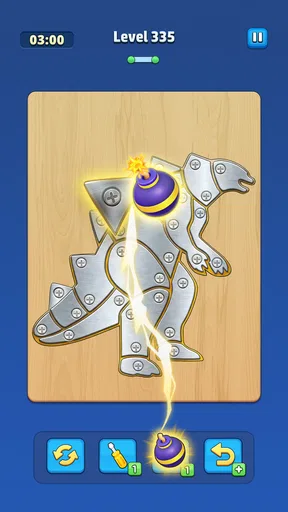
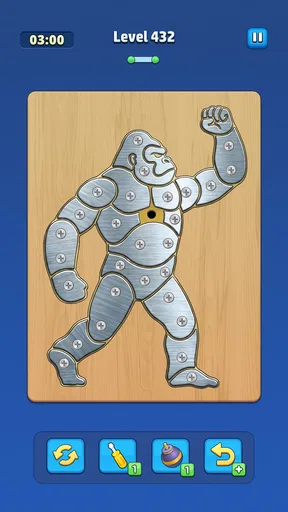
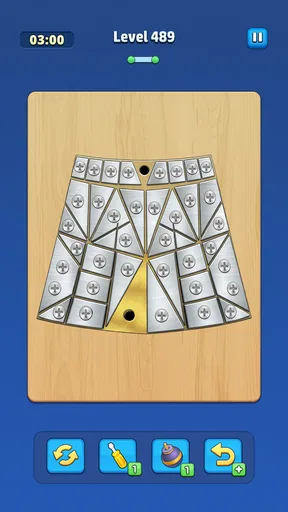
Our Review of Take Off Bolts: Screw Puzzle
 Analysis by Appyee
I found Take Off Bolts: Screw Puzzle easy to understand within seconds, but much less automatic to master than its simple presentation suggests. It is a free puzzle game from Playful Bytes built around removing bolts from crowded arrangements, then using logic to decide where each piece should go next. The basic action is familiar: tap a bolt, open a path, and keep the board from becoming blocked. The interesting part is that every move changes the space available for the following move.
That makes it a good choice for short, quiet sessions. I can imagine opening it while waiting for an appointment, taking a few turns during a commute, or playing for longer when I want something more thoughtful than a reflex game. It is aimed at Everyone, runs on Android 8.0 or later, and is free to install. Optional purchases range from $1.49 to $49.99 per item, so I would approach it as a free game first and decide later whether any optional spending feels worthwhile.
What the first few minutes feel like
The opening experience is deliberately direct. There is no need to learn a long rule set before playing. You look at a board covered with bolts and connected pieces, identify a bolt that appears removable, and test your reasoning by taking it away. The challenge is not the tap itself. It is predicting what that tap will reveal, which pieces will remain trapped, and whether the new arrangement leaves you with a workable route.
For a first-time player, the most useful mindset is to stop treating the board like a collection of individual objects. I had better results when I looked at the whole arrangement as a sequence of dependencies. One bolt may seem convenient because it is visible, while another bolt may be the real key because removing it clears access to several later moves. The game becomes more satisfying once I start asking, “What does this move make possible?” instead of only asking, “What can I remove right now?”
The early puzzles are a gentle introduction to that idea. They let you see the relationship between an available bolt and the pieces around it without demanding a complicated plan immediately. That makes the game approachable for people who do not normally play puzzle titles. You can experiment, notice the result, and gradually develop a habit of checking the board before tapping.
At the same time, the visual simplicity can create a misleading first impression. A board may look nearly solved because only a few bolts seem accessible, yet one careless choice can leave the remaining pieces awkwardly arranged. I found that the game rewards patience more than speed. If you usually play mobile games by tapping the most obvious object as quickly as possible, the first adjustment is learning to pause for a few seconds.
The game’s average rating is 4.1 from around 51 thousand ratings, and it has passed 10 million installs. Those figures suggest that its straightforward idea has reached a large audience, but they do not remove the need to decide whether this particular style suits you. The central appeal is careful sequencing, not constant novelty, social competition, or action.
Getting ready without overthinking it
Installation should feel uncomplicated on a compatible Android device. After opening the game, I would recommend starting with the first available puzzle rather than searching for a perfect strategy guide. The early boards are most useful when you treat them as practice for reading the layout. Pay attention to which bolts are exposed, which pieces appear to overlap, and what changes after each removal.
I also suggest playing the first session somewhere you can give the board a little attention. This is not a demanding game in the physical sense, but it is easy to make a poor decision when distracted. A few seconds of observation can matter more than a rapid series of taps. If you are playing while watching television or carrying on a conversation, the puzzles may feel more frustrating than they really are.
There is no reason to spend money immediately. Since the game is free, I would first find out whether the basic puzzle rhythm holds your interest. Optional purchases between $1.49 and $49.99 per item may appeal to committed players, but a new player can make a sensible first decision simply by playing without buying anything. That is especially important if you are unsure whether you enjoy replaying a board after a mistake.
One small but useful habit is to rotate your attention around the entire board before making the opening move. Do not focus only on the largest or most visible bolt. Look for a bolt whose removal seems to reduce congestion, then compare it with another move that might expose a more important route. This quick scan is the closest thing to a beginner’s setup routine, and it makes the first meaningful success feel earned rather than lucky.
The first successful move and why it matters
My first satisfying success was not simply removing a bolt. It was choosing one that looked slightly less obvious, then seeing how that decision opened the next part of the puzzle. That moment explains the game better than its short description does. The pleasure comes from recognizing a relationship between objects that initially looked unrelated.
For a new player, I recommend using the first board to test one question at a time. Ask which bolt is currently free, which bolt might become free after one removal, and which move could make the board more crowded. You do not need to calculate the entire solution from the beginning. A two-step plan is enough to start. Once that plan works, extend your thinking by one more move.
A practical technique is to identify a “safe” move and a “committing” move. A safe move clears space without obviously blocking anything else. A committing move depends on a particular order and may make later choices narrower. When I am uncertain, I prefer the safe move first, unless the board clearly signals that a specific bolt must be removed before the opportunity disappears.
This approach also helps with the emotional side of puzzle games. A failed attempt does not necessarily mean the board is unfair or that you misunderstood the rules. Often it means the order was slightly wrong. Instead of restarting immediately, I like to remember the first decision that caused trouble and change only that part on the next attempt. That turns failure into a small experiment rather than a complete reset.
The game works particularly well for people who enjoy visual logic but do not want word clues, number grids, or timed pressure. It offers a physical-looking puzzle surface while asking for the same kind of planning found in more traditional brain games. The difference is that the objects and their arrangement make the solution feel more tactile.
Where beginners commonly get confused
The most common confusion is assuming that every visible bolt is equally useful. Visibility is not the same as priority. A bolt may be easy to tap but strategically poor because it leaves a neighboring piece in a worse position. I learned to distinguish between what the board allows immediately and what the board needs in the long run.
Another source of trouble is looking at a single piece instead of the empty space around it. In this type of puzzle, open room is often as important as the bolt itself. Removing something can create access, but it can also change how the remaining pieces sit together. Before tapping, I try to imagine the board after the move, not just the animation of the move itself.
It is also easy to assume that the first move should be the most dramatic one. I found that quieter moves can be better because they preserve options. If two bolts appear removable, the stronger choice is often the one that keeps more routes open for later. This is a useful lesson for beginners because it changes the goal from making progress quickly to protecting future choices.
When a puzzle goes wrong, I would not recommend tapping randomly in the hope that the board will somehow recover. Random play can occasionally produce progress, but it teaches very little and makes the game feel more luck-based than it is. Instead, pause after each move and check what has changed. If a piece becomes accessible, ask whether it should be handled now or saved for later.
There is a trade-off here. Players who enjoy experimenting may like discovering solutions through trial and error. Players who want a clean, predictable path may dislike having to revisit a puzzle because of one early decision. That difference matters when comparing this game with alternatives in the puzzle category. A crossword or word game usually gives you independent clues, while a number puzzle often lets you build certainty cell by cell. These bolt arrangements are more dependent on order, so one choice can affect the whole board.
How I would use it in everyday life
Imagine having ten quiet minutes before a meeting. I would open the game, solve one board carefully, and stop there if my attention started to drift. The format suits that situation because the game does not require a long story recap or a team to assemble before play. I can begin with a visual problem immediately, and the session still feels complete when I finish a puzzle.
It can also work as a short mental reset after repetitive work. Instead of scrolling through several unrelated feeds, I can focus on one arrangement and make a small chain of decisions. That does not make it a productivity tool, but it gives the break a clear shape. The best use is when I want concentration without the weight of a large strategy game.
Families may find the Everyone age rating reassuring, particularly if they want a puzzle that is easy to explain. I would still play alongside a younger child at first, not because the rules are complicated, but because the important lesson is patience. Children who expect immediate tapping feedback may need encouragement to inspect the board and accept that a wrong order is part of the challenge.
On the other hand, I would skip it if I wanted a competitive leaderboard, a story-driven campaign, or quick reactions. The game’s appeal is individual problem solving. It is not the right substitute for an action title, a multiplayer party game, or a puzzle app built around daily word challenges. Its strongest moments come from slowly understanding a physical layout.
What changes as the puzzles become less obvious
As I moved beyond the easiest boards, the important skill became option management. Early on, I could often see a useful move immediately. Later, I had to compare several plausible openings and consider which one preserved the most flexibility. This is where the game stops being a simple tapping exercise and becomes a test of planning.
One advanced habit is to count possible follow-up moves informally. If removing a bolt leaves only one apparent continuation, that line may be risky unless the continuation is clearly correct. If another removal leaves several choices, it may be safer because I can adapt after seeing the new arrangement. This does not guarantee a solution, but it gives me a practical way to judge uncertainty without trying to calculate every move.
A second useful technique is to delay the move that solves an obvious small section when that move might be needed as a reference point for a larger sequence. In other words, not every available improvement should be taken immediately. Sometimes a bolt that appears ready to remove is more valuable as part of a later chain. This is one of the game’s less obvious lessons and a reason experienced players may continue enjoying boards that initially look simple.
A third insight is that mistakes can reveal the board’s structure. If a particular opening repeatedly causes a blockage, that is evidence about the order the puzzle expects. I use that information to build a rough hierarchy: bolts that clear access, bolts that depend on access, and bolts that should be left until the surrounding space is ready. Thinking in those groups is more effective than memorizing isolated taps.
The limitation is that this style can become repetitive if you need constant changes in rules or presentation. The basic interaction remains focused on bolts, pieces, and order. That consistency is exactly why the game is relaxing for some players, but it may feel narrow to anyone who quickly exhausts one puzzle mechanic.
How it compares with familiar puzzle alternatives
Compared with match-three games, this title is slower and more deliberate. There is less emphasis on creating a chain of immediate combinations and more emphasis on preventing a bad future position. If you like watching the board react to fast moves, a match-three game may feel livelier. If you prefer making one considered decision at a time, the bolt format is likely a better fit.
Compared with Sudoku, the reasoning is less abstract and more spatial. Sudoku asks you to track numerical possibilities across a grid, while this game asks you to read physical relationships and access. Someone who enjoys arranging objects and imagining movement may find the bolt puzzles more intuitive than number logic. Someone who wants strict deduction with stable rules may prefer Sudoku’s certainty.
Compared with hidden-object puzzles, it offers less searching and more sequencing. You are not mainly looking for a concealed item; you are deciding what to do with what is already visible. That makes the game more approachable for short sessions, but it may not satisfy players who want detailed scenes, clues, or a narrative reason to keep exploring.
The closest alternatives are other screw, pin, or object-removal puzzles. The deciding factor is not just the theme. It is how much you enjoy preserving future options. If you want a game where every move is mostly independent, choose another puzzle style. If you like seeing a crowded arrangement gradually become understandable, this one has a clear advantage.
Who should install it, and who should pass
I would recommend it to casual puzzle players, people who enjoy spatial reasoning, and anyone looking for a free game that can fill a few quiet minutes without demanding fast reactions. It is also a reasonable introduction to logic games for someone who finds grids, equations, or word clues intimidating. The visual goal is easy to grasp, while the deeper challenge grows naturally from the order of actions.
I would be more cautious about recommending it to players who dislike restarting, dislike repeated attempts, or expect every tap to produce obvious progress. The game can punish an impulsive opening, and that may feel irritating rather than satisfying. I would also point heavy puzzle fans toward a broader alternative if they need several different mechanics in one app.
Because the game is free, the sensible path is simple: install it, play enough to see whether the removal-and-sequencing loop holds your attention, and ignore optional purchases until you know your answer. The current version is 1.23.0, and the Android requirement is 8.0 or newer, so checking device compatibility before installing is worthwhile for anyone using an older phone or tablet.
After a few boards, I would make one personal decision: do I enjoy solving the arrangement, or do I only enjoy the first visual reveal? If the satisfaction comes from planning several moves ahead, the game has room to become a regular short-session habit. If the novelty fades as soon as the basic interaction is familiar, there is no reason to force it.
My final take after learning its rhythm
Take Off Bolts: Screw Puzzle succeeds because it turns a very small action into a surprisingly thoughtful exercise in order and space. I like that the first meaningful success can arrive quickly, while better play requires restraint, observation, and a willingness to revise a plan. The game is friendly enough for a first attempt but not so automatic that every board feels solved before it begins.
Its weaknesses are tied to the same design choice. The focused mechanic may feel repetitive, and players who want speed, story, or competition should look elsewhere. A wrong early move can also make a puzzle feel more frustrating than expected, especially when I am playing without enough attention. Those are real limitations, not reasons to dismiss the game; they simply define the audience clearly.
For me, the best way to approach it is as a compact logic break: scan the board, choose a move that preserves options, watch how the arrangement changes, and treat mistakes as information. That path makes the first session reassuring instead of confusing and gives the later puzzles a fair chance to show their depth. If that kind of quiet, tactile planning sounds appealing, Playful Bytes has made a solid free puzzle game worth trying.
Verdict
Strengths of Take Off Bolts: Screw Puzzle
- Simple tap controls make the game easy to learn.
- Short levels are convenient for quick gaming sessions.
- Gradual difficulty keeps the puzzle experience engaging.
- Satisfying bolt-removal animations make solutions feel rewarding.
- Works well for players who enjoy relaxing mechanical puzzles.
Limitations of Take Off Bolts: Screw Puzzle
- Some levels may feel repetitive after extended play.
- Later puzzles can depend more on trial and error.
- Hints or extra moves may be limited without spending resources.
- The game may include frequent ads between completed levels.
- Players seeking fast action may find the pace too slow.
Other Releases by Playful Bytes
View All
Match Family: Triple Match 3D
Casual4.7

Mahjong Mingle
Board4.8

Find Hidden Cats- Spot it!
Casual4.8

Mahjong Slide: Zen
Board4.7
Similar Picks in This Category
View All
Block Blast!
HungryStudio4.8

Braindom: Brain Games Test
Lahana Game Studio4.6

AMAZE!
CrazyLabs LTD4.6

Sudoku - Classic Sudoku Puzzle
Oakever Games4.7

Art Puzzle - Puzzle Games
Easybrain4.8

Amaze GO!
Oakever Games4.9
Frequently Asked Questions
What is Take Off Bolts: Screw Puzzle and how is it played?
Take Off Bolts: Screw Puzzle is a physics-based logic game in which you remove bolts, screws, and metal pieces in the correct order to clear each level. The main challenge is planning your moves carefully, because removing one fastener can change the position of other parts or leave them unsupported. It is easy to learn, but later puzzles require patience, observation, and strategic thinking.
Is Take Off Bolts: Screw Puzzle free to download and play?
The game can generally be downloaded for free, allowing players to try its core puzzles without paying upfront. However, free versions of this type of game may include advertising, optional purchases, extra hints, or other paid content. Before downloading, it is worth checking the store listing for the current pricing model, in-app purchase details, and whether some features or level packs require payment.
Does the game work without an internet connection?
Many of the basic puzzle levels can usually be played offline once the game has been installed, which makes Take Off Bolts: Screw Puzzle suitable for short sessions while travelling or when mobile data is unavailable. Some elements, such as advertisements, cloud synchronization, updates, leaderboards, or special events, may still require an internet connection depending on the version installed.
Are there hints or tools available when a puzzle becomes difficult?
The game is designed to reward careful planning, but difficult stages may offer hints or assistance to help players continue. These tools can reveal a useful move, highlight a possible bolt, or provide another form of guidance, although their availability and cost may vary. Players should use them thoughtfully, since solving the level independently is usually more satisfying and helps improve puzzle-solving skills.
Is Take Off Bolts: Screw Puzzle suitable for children and casual players?
Take Off Bolts: Screw Puzzle is accessible to casual players because its controls are simple and the objective is explained through direct interaction with the puzzle pieces. Nevertheless, some stages can become surprisingly challenging and may require concentration rather than quick reflexes. Parents should review the app’s age rating, advertising, and in-app purchase settings before allowing younger children to play.
Play our best games!


